Tuesday, May 25, 2010

Conferences, Cotopaxi, Children, Cock of the Rock

Conferences, Cotopaxi, Children, Cock of the Rock

All kinds of stuff has been going on since I got back from Colombia a million years ago:

1) La Hesperia hosted 25 exchange students for a conference.

2) I climbed Ecuador’s 2nd highest peak, Cotopaxi.

3) A group of 17 11-year-olds visited from their private school in Quito.

4) I visited Angel Paz’s refugio de aves.

I also published my first book, Birds of the Tyler Place.

I’ve been working pretty hard on writing up information about the bird inventory here at La Hesperia. That, along with everything else that’s been going on and the usual power/internet problems have kept me off the blog for far too long.


There isn’t too much worth saying about the conference, especially since I don’t have any pictures. There were a lot of presentations about projects students had worked on all over Ecuador, but I was pretty busy and only got to see a few.

Afterwards I went to Quito with vague plans to travel around and see some birds for a bit. I hadn’t had a day off in three weeks so I was ready to take some time away from La Hesperia. But I ran into a bunch of the visiting students and some volunteers in Quito who were planning to climb Cotopaxi. After several aguardientes I decided to tag along. And that is how these sort of mountainous decisions are best made: quickly. That way if any of the multitude of potential snags (bad weather, injury, hypothermia, altitude sickness, etc.) gets in the way, there is less feeling of failure or loss.

Anyway, Colorado, Monkey Dentist, Charmadizzle and I all dragged ourselves out of bed early Saturday morning to acclimatize.
We hiked around in the park on a gorgeous afternoon with this white-capped beast looming in the background.

I haven’t read the manual on altitude acclimatization, but I hoped that my physiology would be able to keep up with the schedule. I am well used to living around 1400 meters (the elevation of the Volunteer House at La Hesperia). I then spent one night in Quito (~2850 meters), one night in the Cotopaxi park hostal (3750 meters) and then a night in the refuge (4800 meters). Though that last night of sleep was really only about 4 or 5 hours.

While the top generally gets plenty of snow to feed glacial advance on all sides, during a sunny day, the snow and ice begin to melt and the risks of avalanches and of ice bridges collapsing into crevasses increases significantly. Therefore one who hopes to summit must depart from the refuge around 1 am with a head lamp in order to leave the glacier by noon.

I awoke at midnight with a splitting headache (probably a result of brain swelling from the altitude) and had no appetite for breakfast (altitude also tends to be hard on the digestive system). But once we starting hiking up I started to feel much better. After an hour-and-a-half or so of hiking up loose gravel and stones, we stopped to slap on crampons and tie on our ropes.

The next four hours were spent trudging slowing up the steep glacier intermittently wondering how much time might have elapsed and how much further we would need to climb, though our guide, advised us not to worry about time or elevation. We began under a clear night sky with the handle of the Big Dipper and Quito lights at our backs and Scorpio visible just above the mountain face in front of us. Around 6 am the sky began to lighten and we could see Cotopaxi’s perfect pyramid shadow stretching out toward the western horizon.

After just under six hours we finally reached the caldera rim.

We saw some fumaroles venting smoke confirming the volcano’s active status and minutes later we saw a huge cloud of ash billowing from another volcano some hundred kilometers to the south.

After only a few triumphant minutes of soaking up 360 degrees of views that included views of essentially every other significant Ecuadorian peak, we had to begin our decent. While we were exhausted and walking down steep glaciers is rather difficult, the weather was brilliant all the way.

Just after we got back to the refuge, an Andean Condor flew by as if to congratulate us.

I’m no mountain climber, though after Cotopaxi I can certainly understand the allure of the pastime. While I’ve somehow learned to derive satisfaction out of spotting a particularly rare bird, reaching the pinnacle of a mountain with whatever superlative attached (second highest peak in Ecuador, world’s tallest active volcano, etc.) is a real thrill that anyone able to achieve such a feat can appreciate.

I missed a couple days of work with the Cotopaxi trip, but made it back just in time for 17 11-year-olds to show up for a few days from the British School in Quito. I taught them about birds at La Hesperia (their favorite was the Ruddy Pigeon because it says “what’s the problem?”) and took them camping.

For the weekend me and Colorado took off for Ecuador’s unofficial bird-watching capital, Mindo, to visit the highly regarded Angel Paz. His Refugio de Aves is a private plot of primary cloud forest where live a startlingly high density of rare and endemic bird species. He really put on a show, introducing us to all his “friends.” It started with a group of lekking blood-red Andean Cock-of-the-rocks (unfortunately a tour group of 8 grizzled Brits tromped in late and scared them away before the sky lightened enough for good photos). Next, a close encounter with the rare Giant Antpitta, “Maria,” that he feeds worms (this day his other antpitta friends found their own food, as can happen this time of year). At the fruit feeding station, Angel hand-fed bananas and grapes to mountain-tanagers and Toucan Barbets and tossed scraps down to eagerly waiting wood-quails and quail-doves. Topping it all was probably the hummingbird feeders around which at least 12 species swarmed like bees.

It was all capped off by a sighting of the rare Orange-breasted Fruiteater eating berries in the Mora patch. One photographer had come specifically to photograph this bird and while the guide urged us all (and especially the Pommies) restraint, Colorado charged in and snapped a few decent shots before the bird flushed leaving the professional empty-handed.

I've only got a couple weeks left at La Hesperia, so I've got to make them count.
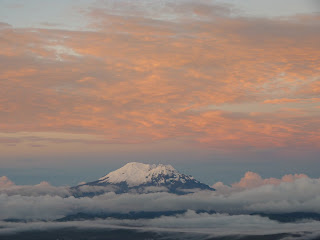
This is Cayambe, another volcanic peak I probably won't get to climb, the evening before we climbed Cotopaxi.


Wednesday, April 28, 2010

Colombia, where everyone is a millonario


I made it back to La Hesperia from Colombia with a few bug bites, but no kidnappings, muggings or trouble with drug cartels or paramilitary groups. I think the bites were worth this spot.

With my visa problems finally solved after a fifth trip to the Ecuadorian consulate, I went straight for gorgeous Tayrona National Park where lush jungle meets the Caribbean Sea.

I was fortunate to find a pack of crackers and some cans of tuna somebody had left in my locker. In the park food costs 3 to 4 times what it does pretty much anywhere else in the country because it has to all be brought in by horse along well worn (and fertilized trails).

While trekking the coastal trails that turned from jungle to beach and back again I encountered several groups of these critically endangered Cotton-top Tamarins.

You can see where the name comes from. I happened to have studied this same species at the Providence Zoo for an animal behavior class a few years ago. To see them in the wild was an awesome surprise.

From the park I went back to Santa Marta, an old charming colonial city that lives in the tourist shadow of nearby Cartagena.

This is where most of the tourists brave enough to come to Colombia spend their time and its no wonder why. The city is a working exhibit in colonial architecture and surrounded by 12 kilometers of ramparts that afford views of city, sea and sound. I spent a full day wandering the maze of narrow streets drinking cheap and ubiquitous freshly squeezed fruit juices.

I was sad to leave the coast and sadder that I missed Colombia’s coffee region, but also looking forward to getting back to La Hesperia. Also another chance to spend some time in Bogota was nothing sneeze at.

For a city that’s probably just before Baghdad on many-a-person’s list of places to visit, it really deserves a second though. Everything is cheap, public transport, though perhaps a bit too “exciting” at times for some, makes getting around a snap, and the people quite friendly for such a dense city.

I rode the Teleferico up one of the nearby mountains my last morning and discovered its just too big to take in with one photo.

One final note: the Bogota futbol team I watched play earlier is called millonarios. But 1 million Colombian pesos is only 500 US dollars, so their name would really translate into something like thousandaires.


Go to Colombia and you´ll instantly be a millionaire!

Sunday, April 18, 2010


Bogota  is a bit like Quito with its old colonial-era quarter, ugly concrete barrios and a backdrop of stunning Andes peaks, but it packs more than 4 times more residents within its limits.  Riding around on the mini-buses (colectivos) is as entertaining as many a Disney World ride and costs just 65 cents.  

I visited El Museo de Oro yesterday to see what pre-Colombian trinkets were salvaged from Europe{s ransacking of the regions precious metals.  I also dropped by the gallery of Botero art (he{s the Colombian who painted the fat people see below)


They also had some work by Picasso and Dali and entrance was free.  

Last night I went out Salsa dancing and this afternoon I went to a thrilling football match in which the local Bogota team "Millionarios" won 2-1.  Colombian soccer fans lived up to expectations for craziness.  In the proper sections (which I was told specifically to avoid; muy peligrosa!) they jumped and chanted the entire match.  

Like Ecuador, essential goods and services are quite cheap by US standards.  For example, at the salsa club last night four Cerveza Costeñas,  cost just 5,000 pesos (2.50 USD).  Back home you might be able to buy a PBR out at a bar for that price if youre lucky.  

Tomorrow morning there will be a moment of truth when I find out for sure whether my visa problems are solved.  If all goes well I will celebrate by making a b-line for colonial Cartagena on the Caribbean coast and then on to beautiful Tayrona national park.  

I have now successfully met up with former Tyler Place staff in four continents.  Asia and Antarctica will be tough to pull off though if I want to complete the circuit.  


Again, no card reader, so you{ll have to use your imagination.  

Friday, April 16, 2010

Life in exile

I stayed to the bitter end of my 90-day visa in Ecuador and nearly didnt make it out in time as downpours caused landslides that closed the highway to Quito.  

I ended up booking a flight in Quito two days ago for Bogota (they seem to be quite cheap last-minute), but found out as I passed through immigration that without applying for a new visa at the Ecuadorian Embassy I would not be able to return to country until January 2011.  

So I went straight from the Bogota airport into a helter-skelter multi-bus journey through a concrete jungle of 7 million inhabitants in search of an Ecuadorian flag.  Despite knowing the cross streets and asking a dozen or so strangers I could not seem to find any Ecuadorian Embassy (it wasnt even in the phone book).  It turned out to be on the 7th floor of a random office building within a block of where I was looking.  I caused a bit of a log-jam in the foyer security checkpoint as my bags were searched (I still had all my stuff with me), with slick suits muttering "permiso" and bustling past what must have looked to them like a lost hiker.  

I stepped off the elevator and was immediately told by the guard (?) wearing an ornate uniform, epaulets and all, that I needed to visit the Ecuadorian consulate rather than the embassy.  

Half-an-hour later at another random office building I found out that the Ecuadorian consulate shuts promptly at 1 pm (it was by this point nearly 4).  

Anyway, this morning I arrived at the consulate early enough to get in and get the laundry list of required documents and forms to complete (which included fees totalling 162,000 pesos {about 90 USD} but no bribes), then run out and complete the scavenger hunt in time to return before the place closed.  

I should have my passport back with a visa in it Monday morning (keeping my fingers crossed).  My plans for Columbia have to change though; this means making some tough decisions about what to scratch from my itinerary.  I really wanted to spend some time on the Carribean coast, but also to see Medellin and a bit of the coffee-growing region.  The country is so spread out and mountainous that bis travel between ny two locations takes roughly a day.  Being in Bogota for the weekend isn{t the end of the world though.  I have four Colombian friends here, one of whom just graduated from a masters program in teaching English as a second language, so I have a party to go to tomorrow night.  

Sorry for the wall of text.  My computer is back at the reserve and there is no card reader on this computer, so pictures will have to come in the for of an addendum...perhaps tomorrow.

Sunday, April 11, 2010

Elementary my dear Hoatzin

I met Pedro at the Quito airport and we took off the next day on a 9-hour trip (involving a plane, a boat, a pickup truck and another boat) to Tiputini Biodiversity Station, a remote research outpost in the heart of a huge swath of pristine old growth lowland tropical rainforest.

The lack of hunting pressure on local populations of macro-fauna makes it a phenomenal place for seeing big game such as monkeys (we saw 8 species including this Squirrel Monkey…


…And these bite-sized Pygmy Marmosets…

…), curassows (we saw seven individuals in one day) and capybara (the world’s largest rodent).

The reserve’s Laguna was also home to bird that through the shear smelliness of its innards has managed to avoid most sources of predation all-together.

This Hoatzin or ‘stinky turkey’ is the only bird in the world that has a diet consisting entirely of leaves. It is also the only bird that has a prehensile claw on the wrist joint of its wings. Depending on which taxonomist you ask it belongs in an order or at least a family of its own.

A lot of other resident birds proved to be at times difficult to see given the immense height of the canopy (some 160 feet) and the density and darkness of the undergrowth. After six days of rather intensive bird hunting Pedro and I managed to collectively see about 170 of the reserves 550 or so species. Our list included some truly fantastic birds that are impossible to see most anywhere else in the world and would impress even the most cold-hearted bird-hater; see Scarlet Macaw, Salvin’s Currasow, Paradise Tanager and Bartlett’s Tinamou (sitting on a nest). Many-banded Aracari may or may not belong on the same line with the previously mentioned birds, but I got a decent picture of one (yes, he looks much like the Pale-mandibled from last time, but they’re just so photogenic).

If you think my photos are any good, then you’re wrong. You should see the ones Pedro has bagged with his 500 mm howitzer. The image quality comes at a price of course…both in cost and in weight. While he has to worry about lugging around an apparatus roughly 20 times heavier and costlier, I’m not sure if his images are actually 20 times better. There is some subjectivity of course. We’ll get a link to some of his best shots up soon.

We got back to Quito just in time to catch Duke’s nail-biting victory over Butler that earned the school its fourth national title.

There was no time to celebrate (we were exhausted anyway) as we got up the next AM several hours before dawn to make our way to La Hesperia for a 30-hour bird-a-thon. I took Pedro all the way from the highway (1100 meters) up to the summit (2000 meters) to see the Choco-endemic and near-threatened Plate-billed Mountain-Toucan (see below) and we saw some 75 other species along the way.

It was really too bad Pedro didn’t have more time to spend down here since he has 1400 or so more birds to see. But he did manage to help me find a couple of new species for the La Hesperia list and adding to those a handful of others found over the weekend while camping at the summit, the official total is now well above 300.

Well I’m sure that’s about as much birds as anyone can handle for one post (it’s Pedro’s fault). Next time around things will be different. I’m leaving this week on trip, destination unknown to renew my visa. I’m thinking Columbia, but possibly Peru. Any suggestions are welcome.

In the meantime I’ve got to decide on what I’ll be doing for the next 1 to 5 years of my life. Please, no suggestions.


Sunday, March 21, 2010


Sunday, March 21, 2010

The computer has been broken for awhile so I have no idea when this post will get out to all my concerned and alert readers.

I spent the weekend at La Hesperia, which meant no chance to watch March Madness, though the chances of watching Duke, I figured, were pretty low anyway from previous experience. For all I know they are playing at this moment for a spot in the Sweet 16.

Instead I got to go camp up at the summit of La Hesperia.


A beautiful spot and we got to hike back down through a portion of the reserve’s Bosque Primario the morning after.

I got to see flocks of the near-threatened Plate-billed Mountain-Toucan which, of all the1600+ species found in mainland Ecuador, is the one that is featured on the cover of my field guide.


Unfortunately none of the pictures turned out that well (too many orchids and clouds in the way). But here’s a good one of a very cooperative (and sad-looking?) Crimson-rumped Toucanet I found just by the volunteer house.

We lucked out on weather though and had the first non-rainy 30-hour streak I’ve experienced so far here.


Undoubtedly our good fortune was granted by this leprechaun disguised as a baby Ecuadorian Thrush that Jorge-Luis caught just as we were departing.

A lot has been going on…

In the past week we’ve built a caterpillar apartment in which we have begun a breeding program.


So far we have about 10 larval monarch tenants, two of which have already made cocoons. We’ll start planning and building a proper butterfly house soon.

Two Canadian farmers have completely renovated the organic garden and foolishly left me in charge of keeping it maintained.


Here’s the shot just after they completed their work. After a few weeks of misguided volunteer efforts I’m sure we can reduce these smooth rows into a smoldering crater.

Fortunately I’m off to the Amazon for a week come the 29th so I’ll be able pass the blame off to someone else!


Tuesday, March 16, 2010

Feliz Cumpleaños a mi

This was written 12 years ago back on March 15, 2010....

The computer monitor died while I was away so I haven't been able to post.

---------

I went into Quito over the weekend for a few reasons: 1) to watch Duke basketball, 2) get a yellow fever vaccination for my upcoming trip to the Amazon, and 3) celebrate my 25th birthday.

1) There’s some sort of blackout on Duke games in Quito. On Friday night I got see Maryland play Georgia Tech and witnessed, with joy, enough Gary Williams exasperation to last me a season. But for the semifinal Saturday and final Sunday I was forced to watch Atlantic-10 garbage and hope for halftime highlights.

2) The Ministry of Health is closed on weekends so I had to extend my weekend through to Monday morning. But if it happens to be a weekday, the health care system here is amazingly efficient and cheap. I made it in and out in under 15 minutes and the cost?...a whopping zero dollars. They didn’t even charge an extranjero tax.

3) I had a really fun weekend and a great birthday. Somehow though my bank (Etrade grrr….) screwed up my last fund transfer and I ended up with essentially $20 for the weekend. Now Quito is a relatively cheap city, especially if you get away from the heart of Gringolandia, but my room alone was going to cost $12 per night. Luckily I had brought my driver’s license as proof of my quarter-century achievement which made asking favors of strangers and semi-strangers consistently successful. And since I had to stay through Monday anyway, I was able to put off paying for the room until cash came through.

Now usually I base my blog around pictures I happen to have taken, but really none apply to any of the above stories.


So here’s a massive slug one of the Canadians found when we were out hiking the other day.

Also, I’ll refer you back to my first post from Ecuador in which I expressed perplexity regarding the popularity of 3-on-3 white-collar volleyball in Quito parks. I recently found out the game is called “ecuavolley” and the players (and probably many of the spectators) wager hundreds or thousands of dollars on matches. We’re building a court at La Hesperia so we can practice and plan our great gringo ecuavolley hustle fundraising event.

I’ve got a lot of logistics planning to do in the next few days. Now that I have my vaccine I can go visit Tiputini (the most biodiverse place in the world). I’m trying to get my friend, ‘Pedro’ who’s coming into town, involved as well, but he doesn’t have much time and getting to and from the place can only be done on Mondays and Fridays and takes all day.

And then after that I have to leave the country for visa renewal purposes. I’m thinking a week in Peru, though there was a landslide in Macchu Pichu so it may be closed. Any votes for Columbia or elsewhere? For whatever reason there are no direct flights to Buenos Aires so getting to Argentina is a bit more expensive and time-consuming.

It wouldn’t be a post without a bird pic.

I finally got a good picture of a Pale-mandibled Araçari, a bird found only in Ecuador. It looks almost like a Muppet no?